

bad corporate actors
The Corporate Sabotage of America’s Future
Excerpts by Robert Weissman and Joan Claybrook
© 2023 Public Citizen
“The evil genius of the Sackler family that founded and ran the opioid maker Purdue Pharma lies in marketing. Opioids have been around and used for pain relief for millennia. The Sacklers didn’t invent a particularly novel product with OxyContin. They invented a new marketing strategy.
“Drug companies, distributors and drug-stores all got in on the act: a lot of money could be made selling opioids, if you were willing to look the other way and ignore the fact that it was abuse, not legitimate use, that drove sales.
“It took decades for law enforcement and the judicial system to catch up with the opioid makers and distributors and end their wrongdoing. By the time they did, the opioid addiction epidemic was raging. Illegally manufactured drugs, especially illicit versions of the super-powerful opioid fentanyl, simply replaced the FDA-approved opioids on the street.
“The modern opioid addiction epidemic in the United States traces to 1995 and the FDA’s approval of Purdue Pharma’s new opioid, OxyContin.
“Regulators let the company make a claim for the drug that the agency officials have not allowed for any other drug before or since,” writes Barry Meier in Pain Killer: An Empire of Deceit and the Origin of America’s Opioid Epidemic…“The FDA permitted Purdue to imply that OxyContin might pose a lower risk of abuse than traditional painkillers because it was a time-release narcotic.”
“The claim of reduced addictiveness became the linchpin of Purdue’s marketing strategy. The company launched an elaborate, sophisticated campaign to convince doctors that they had been under-treating pain—and that OxyContin was the answer to the problem they had failed to treat. The company invited thousands of doctors to junkets where Purdue spread its gospel. Purdue paid hundreds of doctors to participate in its speakers’ bureau and persuade other physicians to join in prescribing OxyContin.
“By 1998, Purdue had hundreds of full-time sales reps pushing OxyContin. Their marketing push centered on OxyContin’s purportedly less-addictive qualities.
“The campaign worked. Purdue’s sales soared. Doctors casually wrote prescriptions for back pain and other chronic conditions. Dentists would order up a month’s supply of OxyContin for dental work that might cause two days of significant pain. In the course of all this, a lot of people who were prescribed OxyContin ended up addicted to it. And as the drugs became plentiful, they started being shared for recreational use.
“Some doctors and associated “pill mill” pharmacies started writing and filling scripts with reckless abandon. With a concentration in Appalachia and New England, the opioid addiction epidemic took off.
“This is an ongoing public health catastrophe that was entirely preventable. Bad corporate actors knew what they were doing, but they didn’t take account of the lives they were sacrificing, or simply didn’t care. It was wicked. And we will be dealing with the consequences for many, many years to come.
“(L)itigation, along with the heroic advocacy of families affected by the epidemic, eventually led to a clampdown on industry supply of easy-access opioids.
“In many ways, however, it was too late. Not only had the industry directly inflicted vast damage, it had built a huge market.
“When legally manufactured pills dried up on the streets, they were quickly replaced with the illegal opioids now washing over the country.
This is a story of merciless corporate enrichment and callous disregard for human life, personal dignity and community trust.
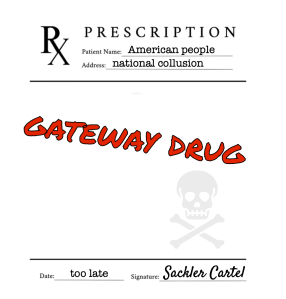
It’s also the backdrop to a bigger story. DPA started advocating politically in 2000. That was five years after the FDA approved OxyContin. The above authors note that while the people making money off the sale of their drug knew how addictive and over-distributed it was, it took decades for the rest of society and the state to put it all together.
What I’m saying is: for many years while they were pushing voters and legislators to the left on drug policy, the people working for DPA did not understood how primed the country was for drug misuse either.
But how can they ignore it now?
There is so much more drug exposure in North America; we are living in a different world than the one understood by Ethan Nadelmann and his funders in the 1990s. Drugs are stronger, cheaper, more poisonous and more available.
Also, ubiquitous cell phones and social media did not exist yet! You had to look for drugs out in the world, they were much harder to find, therefore there were less opportunities to abuse them. In the current age of mass addiction, synthetic opioids, international drug cartels and supply chains that reach us through personal devices that many people are tethered to, increasing access to drug has much different outcomes.
Let’s use DPA’s own criteria: “even if use went up somewhat, but death, disease, crime and suffering generally went down, that’s progress.” Since 2020, when DPA and their allies brought drug decriminalization to Oregon,
Drug use HAS gone up somewhat and Death, disease, crime and suffering HAVE generally gone up as well.
 demainstay.com