
“So Why Don’t You Go to Soros?”
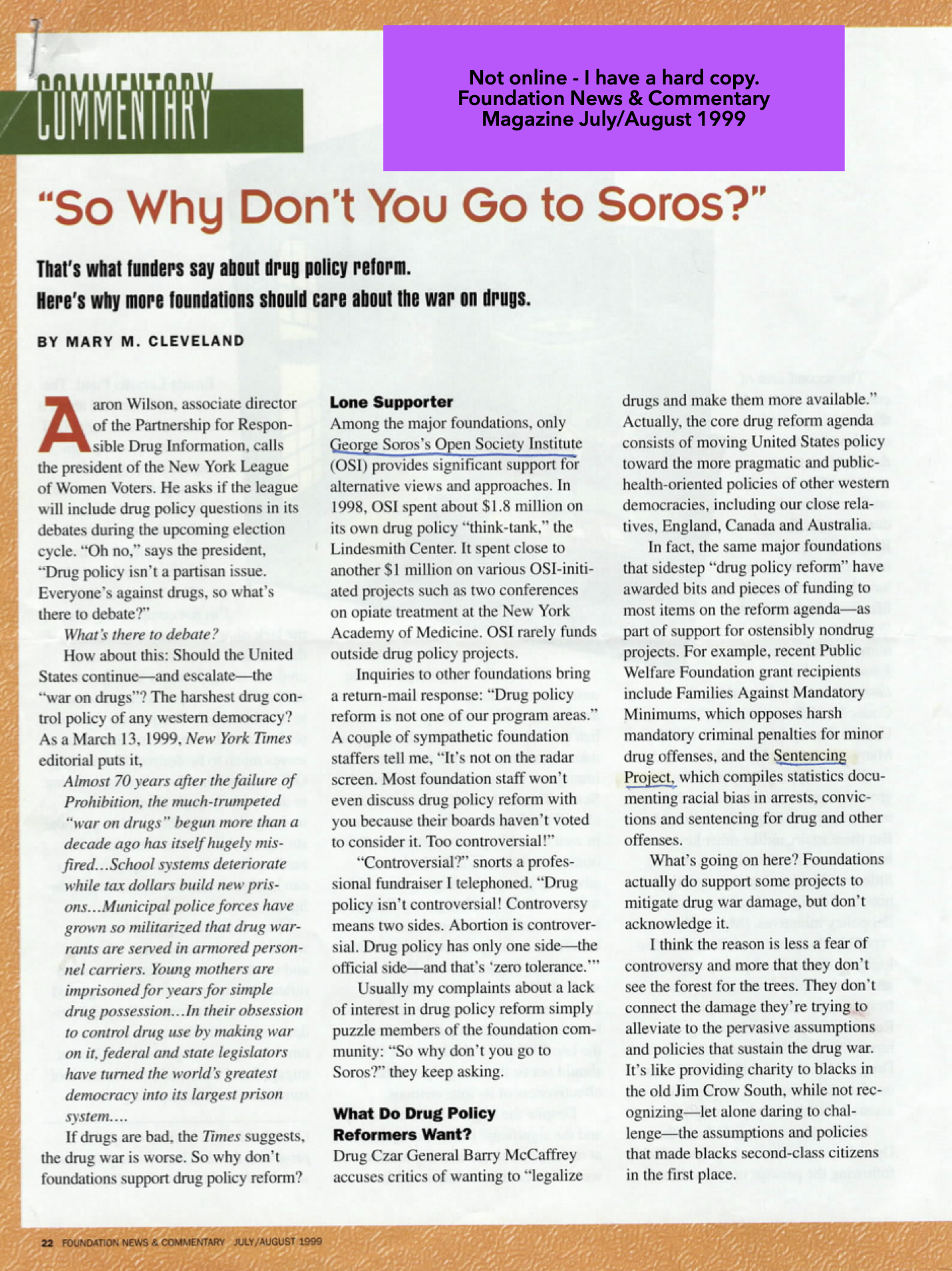
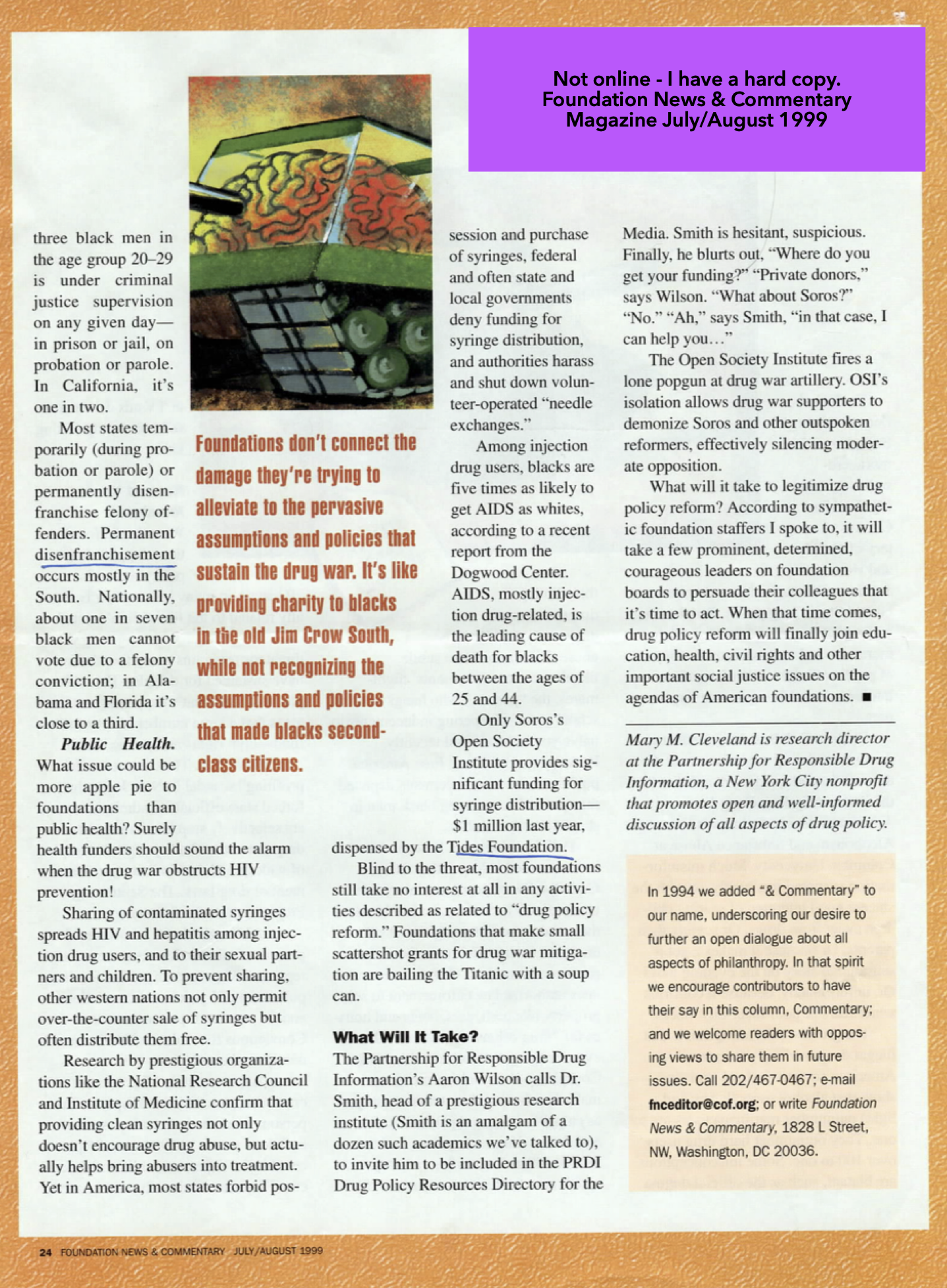
I’ve had this magazine article, written by a sympathetic nonprofit professional, for 25 years. At that time, I supported the direction George Soros and Open Society Institute (OSI) were taking the country on drug policy.
Quotes are from the article. I selected them to illustrate the no-go vibe around drug policy reform and OSI’s unique position prior to 2000.
“Drug Policy isn’t a partisan issue. Everyone’s against drugs, so what’s there to debate?”
“Most foundation staff won’t even discuss drug policy reform…because their boards haven’t voted to consider it. Too controversial.”
“Controversial?…Drug policy isn’t controversial! Controversy means two sides…Drug policy has only one side — the official side — and that’s ‘zero tolerance’.
“Moral crusaders — including [Democratic] President Clinton’s Secretary of Health and Human Services, Donna Shalala — dominate United States drug policy.
“The drug war enjoys…near-unanimous support of public officials.
“OSI (Open Society Institute) rarely funds outside drug policy projects.
“OSI’s isolation allows drug war supporters to demonize Soros and other outspoken reformers 1, EFFECTIVELY SILENCING MODERATE OPPOSITION.
[Democratic President Bill Clinton’s] “Drug Czar General Barry McCaffrey accuses [drug war] critics of wanting to ‘legalize drugs and make them more available’
From an eye on how social and ideological commitments change over time, consider: in the 1990s there was nonpartisan consensus that “drugs are bad” and should be discouraged including through the criminal justice system. In the 2020s we have one political party who actually DO vote to make drugs more available and to remove drug use from judicial oversight.
How did we get here?
First, OSI established drug policy as a philanthropic “program area” thereby legitimizing drug reform as an appropriate nonprofit focus. After legitimizing drug reform in the philanthropic arena, they did the same in the political arena through first introducing citizen initiatives targeting drug laws and then by aligning many legislators in the Democratic Party to the OSI/DPA drug policy vision. Today, social media connects them directly onto the screens of the progressive voter base they hope to engage.
All this noise shifts public perception.
July/August 1999
Foundation News & Commentary Magazine
Mary M. Cleveland

- In the 2000s while marijuana was still illegal across the country, there were two other major drug reform donors. Peter Lewis, the chairman of Progressive Insurance was an outspoken advocate for marijuana reform. And George Zimmer, the founder of Men’s Warehouse, was also en enthusiastic marijuana reformer. Neither of these donors (one is deceased) followed OSI into funding access to ALL the other drugs (also they spent tens of millions and Soros has spent hundreds of millions).
 demainstay.com