

Legalization and decriminalization are not the same thing
Both refer to drug laws that increase user access, but criminalization and legalization have MORE in common than legalization and decriminalization. And that is the justice system.
Drugs can’t be charged with a crime; we can’t put a warrant out for the arrest of methamphetamine. It’s what people do with drugs that make it criminal. Decriminalization removes criminal penalties for drug possession, but drug possession is only one silo of drug law. Decriminalization will always be an incomplete solution to a complex issue.
Generally, people possess drugs for two reasons: with the intention of taking it themself or with the intention of distributing it to others. People who distribute drugs to others don’t do it for free. It’s assumed that drug distribution is commodified. So there are distinct legal circumstances for buyers who only use, sellers who only deal and users who are also sellers.
Examples: a person selling drugs to support their own habit evokes a sympathy that the calculating drug dealer who never touches the product doesn’t. It’s more challenging to prosecute the dealer when they’re a trafficked juvenile forced to sell drugs on the street by cartels.
The government doesn’t just regulate drugs to be a buzzkill. When a drug is controlled that means authorities have determined three things: 1. The drug has the potential for abuse 2. It has a likelihood of producing dependence. 3. It has — or doesn’t have — a legitimate medical use. Drugs are graded on this risk/reward ratio and placed into 5 schedules, schedule I through schedule V, schedule I being the drugs with highest abuse potential and least medical benefit. Policymakers refer to these schedules when making sentencing suggestions for drug crimes.
It’s fair to criticize these classifications
Marijuana is a Schedule I drug and fentanyl is a less dangerous Schedule II. An imperfect classification system does not, however, excuse DPA from lobbing congress to keep fentanyl as well as future synthetic opioid derivatives off the drug scheduling list all together (and therefore completely protected from judicial oversight). Further, fentanyl isn’t free. It’s only sold by international cartels who export it to the U.S.
Isn’t lobbying for fentanyl also kinda like lobbying for the cartels?
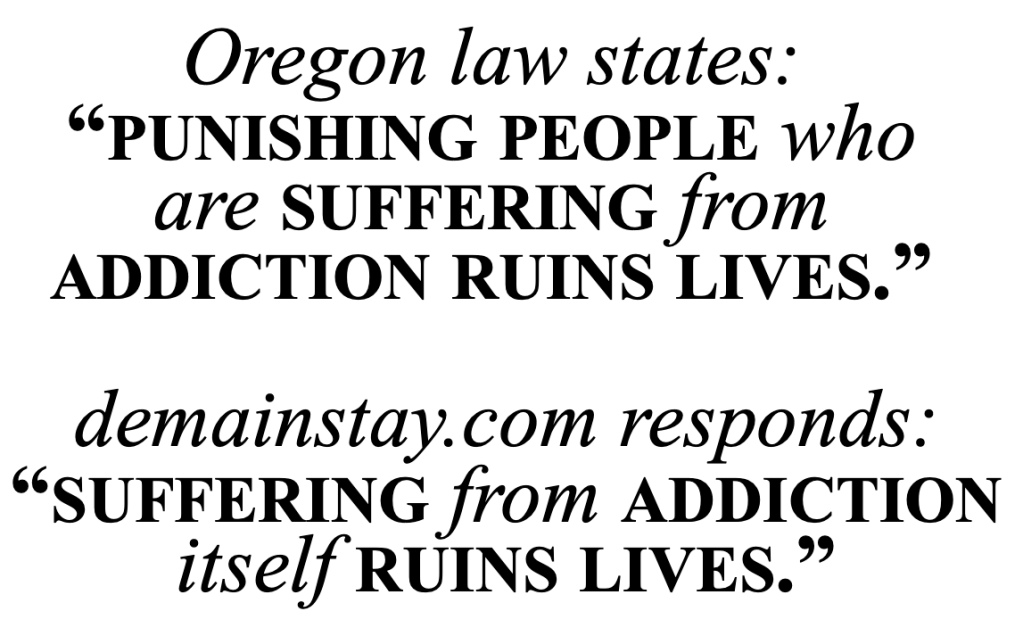
When substances are criminalized, they fall under the umbrella of the justice system system which includes regular courts & specialty drug courts. When substances are legalized they are subject to state regulation for things like potency and purity, batches are trackable for accountability and tax revenue is generated. In both circumstances, authorities have determined that it is legitimate state business to interfere with drug possession, use and low-level sales.
Not so with decriminalization. Decriminalization means that drug use, drug possession, possession of equipment used to introduce drugs into the human body, such as syringes and low-level drug sales have zero restraints. It’s a blunt tool — no crime, no punishment.
Decriminalization removes court oversight and legal consequences. For those whom contact with the justice system is a ticket out of drug dependency, losing this off-ramp is especially consequential.
By lobbying congress to keep it unscheduled, DPA wants fentanyl and future drugs like it to be unencumbered in the marketplace. This will increase access because when you cut the judge out of a deal, drug sales are just another transaction between buyer and seller. And the market speaks.
Is this sufficient supervision for such deadly substances?
Proportionality is a consideration when comparing legalization and decriminalization. Cannabis had been legal for adults 21 and older in Oregon for FIVE YEARS before we decriminalized everything else in 2020. With a medical card today, youth 18 and over can legally buy marijuana products. That means it is — illegal — to sell marijuana to someone younger than 21 in every other circumstance. Due to their quasi-criminalized status, selling meth, heroin or fentanyl to a teenager would bring a lesser criminal penalty than selling them weed. Is that good public policy?
Decriminalization also muddies the legal circumstances around prosecuting drug dealers which leaves an opening exploited by the cartels to increase their market dominance.
Fentanyl should be controlled, Discouraged and Resisted by both parties
By lobbying congress for unregulated fentanyl or by insisting on decriminalization efforts in Oregon, despite grievous human suffering, DPA, their partners on the ground and legislative allies are on the wrong side of a state and national tragedy.
 demainstay.com